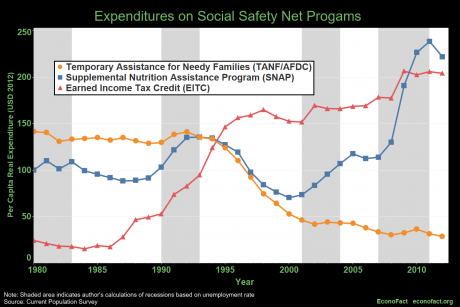
During economic downturns the social safety net can play a
critical role for families as well as for the economy more
broadly. Social programs can protect vulnerable families by
making it easier for them to continue to meet basic needs. The
social safety net can also act as a fiscal stimulus — increasing
government spending when other spending is in retreat — and, in
so doing, prevent further job loss. However, over the past couple
of decades there has been an important shift in U.S.
A new rule to restrict legal immigration, published by the Trump
administration this month, is sowing confusion and anxiety even
among immigrants not directly affected by it, as fear spreads
faster than facts, immigration and health policy experts say.
The rule would allow the federal government to more easily deny
permanent residency status, popularly known as green cards, or
entry visas to applicants who use — or are deemed likely to use —
federally funded food stamps, housing assistance and Medicaid.
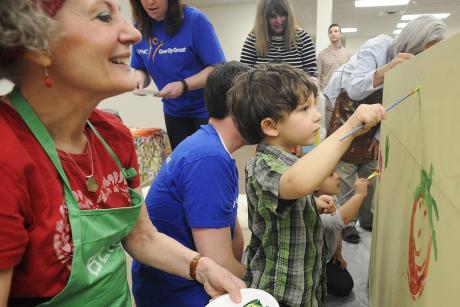
Center for Poverty Research Director Marianne Page and
Faculty Affiliate Ross Thompson were invited to speak on a panel
at the Childhood Obesity Conference in Anaheim, CA
July 15-18. Their session entitled “Poverty: Obesity
Prevention’s Top Priority?” discussed how childhood obesity is
tied to so many other issues—poverty, family supports, and
healthy communities.
Marianne Page, professor of economics at UC Davis, will lead a
team of experts from UC Davis, UC Berkeley, UC Irvine, UCLA, UC
Santa Barbara and UCSF to shift from fragmented,
discipline-specific approaches of studying childhood disparities
to a multidisciplinary, comprehensive examination of the issue.
The project goal is to understand how health and nutrition
programs affect the health and development of disadvantaged
children, as well as build relationships with policymakers.
Caitlin Patler, an assistant professor of sociology, whose
research focuses on migration, inequality and
“crimmigration,” recently received the Pacific Sociological
Association’s Distinguished Contribution to Sociological
Perspectives Award.
The award recognized “To Reveal or Conceal: How Diverse
Undocumented Youth Navigate Legal Status Disclosure,” the paper
she published in the association’s journal last year.
Growing up in impoverished urban neighborhoods more than doubles
your chances over the average person of developing a
psychosis-spectrum disorder by the time you reach middle
adulthood, according to a new UC Davis and Concordia University
study of nearly 4,000 families who were monitored over 30
years.
CPR Faculty Affiliate Cassandra Hart’s work on
teacher-student race and academic outcomes featured in the New
York Times. From the article:
“When black children had a black teacher between third and fifth
grades, boys were significantly less likely to later drop out of
high school, and both boys and girls were more likely to attend
college….The effect was strongest for children from low-income
families.”
Losing a parent is one of the most profound stressors a child can
experience; it threatens the child’s safety and causes a
heightened state of “fight or flight.” This type of stressor
rapidly increases the child’s heart rate and blood pressure.
Stress hormones like epinephrine and cortisol flood the system.
Fear and panic take over. Decades of science suggest
that these separations are traumatic and likely to cause lifelong
mental and physical health problems.
There’s plenty of financial advice available for people with a
little extra money to spend — put more money in your 401(k),
create a rainy-day fund, start planning for your child’s college
education. But where do you go for tips if you’re struggling to
make ends meet?
Ann Huff Stevens of the UC Davis Center for Poverty
Research points out that advice often given to the poor
tends to miss the mark and doesn’t address some of the
root causes that push people into poverty and keep them there.
No group is as linked to poverty in the American mind as single
mothers. For decades, politicians, journalists and scholars have
scrutinized the reasons poor couples fail to use contraception,
have children out of wedlock and do not marry.
The reality, however, is that single motherhood is not the reason
we have unusually high poverty in the United States, compared
with other rich democracies.
In March, researchers at the University of California published a
pioneering study that links the “legitimizing effect” of the DACA
program with participants’ improved psychological well-being in
California. The state has, by far, the largest population of
beneficiaries, 223,000 people out of nearly 800,000 DACA
recipients nationwide.
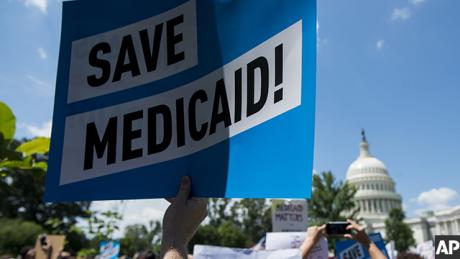
The widely expected passage of the tax reform bill will almost
undoubtedly cause significant harm to Medicare. And provocative
statements by President Trump and House Speaker Paul Ryan
declaring that “entitlement reform” will be next threatens
Medicaid. Put these two together and, I think, one thing is
clear: Big Medicare and Medicaid cuts are coming.
The report asserts that the basic needs for people with
disabilities go beyond what is covered in the official U.S.
definition of poverty and that a new definition of poverty could
help highlight the financial challenges facing people with
disabilities and influence changes in policy.
A new proposal by Democratic Sens. Michael Bennet (CO) and
Sherrod Brown (OH) would provide a child allowance. The American
Family Act of 2017 would dramatically expand the child tax
credit, which currently offers up to $1,000 a year for families
with significant earnings but little or nothing for many
poor people.
California has 11 of the 20 most-affluent cities in the nation,
while Florida and Ohio each have four cities on the list of the
20 poorest cities, based on an analysis of 2016 median household
income.
The data comes from the U.S. Census Bureau’s 2016 American
Community Survey, the results of which were released this
month. The release included numbers for the 599 U.S.
municipalities and 806 counties with at least 65,000
residents.
Although it started as a plan to cover only the poor, Medicaid
now touches tens of millions of Americans who live above the
poverty line. The program serves as a backstop for America’s
scattershot health care system. Today Medicaid is the
nation’s largest health insurance program, covering 74 million
people — more than 1 in 5 Americans. Twenty-five percent of
Americans will be on Medicaid at some point in their lives
The poor or near-poor are the first knocked down by storms and
the last to get back up. Natural disasters push 26 million people
around the world into poverty annually, according to the World
Bank.
New research suggests programs aimed at helping low-income U.S.
children, such as Head Start early childhood education and
Medicaid health coverage, may have benefits not only for
participating children but for their children as well.
New research on a program in Mexico gives us a real-world
test case for the idea that providing universal basic income
would cause inflation. And it strongly suggests that giving out
cash doesn’t cause inflation — or if it does, the effects are
very, very mild.
In a stark reminder of the damage done by the Great Recession and
of the modest recovery that followed, the median American
household only last year finally earned more than it did in 1999
and in effect boosting more people out of poverty.
Five days earlier, his mother had spent the last of her
disability check on bologna, cheese, bread and Pepsi. Two days
earlier, he had gone outside and looked at the train tracks that
wind between the coal mines and said, “I don’t know how I’m going
to get out of this.” One day earlier, the family dog had
collapsed from an unnamed illness, and, without money for a
veterinarian, he had watched her die on the porch. And now it was
Monday morning, and Tyler McGlothlin, 19, had a plan.
Both proposed versions of the Republican health care bill—the
American Health Care Act (AHCA) and the Better Care
Reconciliation Act (BCRA)–create an option for states to receive
Medicaid funds in the form of a block grant (in the BCRA, the
Medicaid Flexibility Program). The lessons from welfare reform
can provide valuable insights into the potential impact of
Medicaid block grants: namely, states may have a considerable
incentive to pursue block grants, because they pose an attractive
opportunity to cut state spending and allocate Medicaid dollars
for other uses should the state desire that outcome.
Research on depression in adolescents in recent years has focused
on how the physical brain and social experiences interact. A new
University of California, Davis, study, however, shows that
adolescents with large hippocampal volume were more, or less,
susceptible to feelings of depression depending on how unsafe —
or conversely — protected they felt in their home and community
environments.
SACRAMENTO, Calif.—In making their case for California’s policies
on climate and immigration, Democrats proudly note the state’s
status as one of the world’s most powerful economies, driven by
thriving tech and creative industries.
Republicans here are pointing to a different metric: the poverty
rate.
“Poverty is the No. 1 issue for California.… We have to work to
fix it,” said Republican state Assembly leader Chad Mayes. “It is
directly related to the policies we have put in place in
California.”
On a frigid morning here, Nancy Godinez was piling bread and
other staples into her car outside a food pantry. She had lost
her job as a custodian, her unemployment checks had run out, and
her job search had proved fruitless.
One thing she still had was health insurance, acquired three
years ago after Arkansas’ Republican-controlled legislature
agreed to expand Medicaid under the Affordable Care Act. The
coverage, she said, has allowed her to get regular checkups and
treatment for tendinitis in her foot.
STOKE-ON-TRENT in northern England is home to the world’s
second-oldest professional football club, Stoke City FC. Founded
in 1863, it enjoyed its heyday in the mid-1970s, when the club
came close to winning the top division. The playing style was
described by its manager, Tony Waddington, as “the working man’s
ballet”. These days the flair is often provided by players from
far afield. More than half the first-team squad comes from
outside Britain, mostly from other parts of Europe. But that is
about as far as Europhilia in Stoke goes. In June’s referendum on
Britain’s European Union membership, the city voted strongly for
Brexit.
With roots in blue-collar Scranton, Pennsylvania, years as first
lady of Arkansas and a 2000 Senate campaign that featured a
“listening tour” of small-town New York, it’s not surprising that
Hillary Clinton’s campaign website has a full page devoted to
helping the rural poor, including a jobs and economic development
plan.
Last year marked the greatest improvement in the typical
American family’s finances on record, according to a
new annual report from the Census Bureau, especially for the
working poor.
We’re in the midst of a hot, dry summer. While you’re thinking
about how you’ll cool off, consider this: four times more
Californians than the entire population of Flint, Michigan do not
get clean, safe water from the tap in their homes. They live
where water must be trucked in for drinking and cooking. Where
they wait in line to shower in public trailers. And where they’ve
been living like this for a long time.
HILLARY CLINTON’S presidential campaign is premised, at least
implicitly, on the idea that if you liked her husband Bill
Clinton’s presidency, you’ll love hers. That’s understandable,
given that the period between 1993 and 2001 saw economic growth,
balanced budgets and declining crime. At the same time, it was
inevitable, and also fair, that her opponents in 2016 would
challenge this upbeat narrative.
What a job looks like has changed for many people since the
recession. In general, things are looking up: Both
unemployment and jobless claims are falling. But a good
chunk of job creation has come
at the highest and lowest ends of the
spectrum, a trend that has only recently started to
change with gains for middle-wage earners. Many people who lost
well-paying jobs have found work, but for less money, doing
hourly retail and food services jobs.
If US presidential candidate Donald Trump wants an immigration
system that works for Americans, he might want to consider one
with far fewer restrictions than he’s proposing.
Immigrants don’t cause high unemployment. In fact, a century
of data suggests Trump has both his chronology and his causation
reversed—it shows that a thriving US job market causes
immigration to rise.
Where in California has the gap between rich and poor grown most
since the recession? The Bay Area, home of some of the most
expensive ZIP codes in the country, seems like a logical answer.
Where in California has the gap between rich and poor grown most
since the Great Recession?
The Bay Area, home of your Zuckerbergs and Steyers and some of
the most expensive zip codes in the country, seems like
a logical answer. Over the past decade, what other part of
California has minted as many members of the “1 percent” as
Silicon Valley?
With no air conditioning on a brutally hot summer afternoon,
19-year-old Breeze Bunch is sitting on the front porch with a
half-empty Pepsi and a bottle of sunscreen.
“Why don’t you go splash in the water?” Bunch tells her
2-year-old daughter, who waddles off toward an inflatable kiddie
pool under a shade tree beside the house.
More discussion about this week’s US Supreme Court ruling on
abortion: The debate around this case includes many controversial
topics though the Texas law in question specifically addressed
regulations for abortion clinics.
Presidents are usually effusive, grandiose, and triumphant when
they sign major legislation that will form a huge part of their
legacy. In 1996, Bill Clinton’s announcement that he’d
sign a bill ending “welfare as we know it” was not that.
HILLARY CLINTON’S presidential campaign is premised, at least
implicitly, on the idea that if you liked her husband Bill
Clinton’s presidency, you’ll love hers. That’s understandable,
given that the period between 1993 and 2001 saw economic growth,
balanced budgets and declining crime. At the same time, it was
inevitable, and also fair, that her opponents in 2016 would
challenge this upbeat narrative.
A day after Alex Gustafson’s wife gave birth to their daughter in
December, he officially began the 12 weeks of fully paid family
leave offered by Automattic Inc., the San Francisco tech company
where he works.
Anthony Goytia of La Puente wishes he had that option. When his
wife gave birth to their daughter in April, they lost about $550
of monthly income. So Goytia started working a second job at
Macy’s to supplement his early shift unloading trucks at UPS.
California’s wealthiest taxpayers are the state’s only group
experiencing rising incomes, a reflection of a broader national
problem of growing wage inequality.
There are several ways to save money on, say, a roll of toilet
paper. You can reach for the cheaper version: the store brand, or
the singly-ply TP, or the stuff that feels like packing paper. Or
you can buy in bulk, saving on each roll per unit. Or you
can stock up when the deal is good, like when the
corner store offers two packs for the price of one.
nald Trump’s economic message is loud and clear: Misguided
Washington policymakers have allowed foreign countries to steal
American jobs, and uncontrolled immigration is driving wages
down.
Marcos Murillo was lured by the American dream. When he left
Chiapas, Mexico he promised his five siblings and his mom, who
were living in a single room shack without electricity, that he’d
send money from the other side of the U.S. border.
He says he thought, “I’m going to be rich, I’m going to be
sweeping money out of the floor.”
In light of President Barack Obama declaring a state of
emergency over the polluted water supply in Flint, Michigan,
should obesity be a concern in Flint? What does safe drinking
water have to do with obesity, you may ask? Efforts to improve
water supplies and to curb obesity have been historically
separate. However, might a shortage of good drinking water
be a factor in the rise of obesity?
The first day back from winter break can be restless.
Many children are still coming down from the excitement of the
holidays. Two unstructured weeks away from school — with strange
food, rituals and relatives — can be overwhelming for many
children, especially when it grinds to a halt after the new year
and normality resumes.
But for students whose families are struggling in poverty, time
away from school isn’t an exciting blip on an otherwise calm
school year. For them, it can be a crippling time of insecurity
when it comes to food and shelter.