Legislation to provide nearly a billion dollars in middle-class
college and university scholarships passed the Assembly on
Wednesday, but lawmakers have not yet taken up a companion bill
to provide funding. The funding measure, Assembly Bill 1500, is
fiercely opposed by most Republicans, branded a tax hike by
business opponents, and faces far tougher sledding getting the
required two-thirds super-majority vote in the Legislature.
Middle-class scholarships will not be provided unless both bills
pass the Legislature and are signed into law.
Research Affiliate Giovanni Peri has proposed a new immigration
permit system that would replace the current waiting list and
lottery with a work permit auction. The new approach is based on
Peri’s economic research that found that immigration often helps
native-born workers in the U.S. by raising overall productivity.
Unemployed workers in rural California are bracing for next
Saturday: the day the state’s chronically unemployed will be cut
off from the nation’s jobless benefits. A drop in California’s
unemployment rate to 11 percent – its lowest mark in three years
– is triggering the federal cutoff of emergency long-term
unemployment pay to at least 93,000 Californians.
Parents hoping to enroll their children in the best public
schools have long known that where you live matters and that
housing prices can be dictated by the quality of the nearby
schools. A new study from the Brookings Institution quantifies
that price gap, and the differences between the cost of living
near a high-scoring public school and a low-performing one are
striking.
It is tax time, the season when the country’s largest antipoverty
program, the earned income tax credit, plows billions of dollars
into mailboxes and bank accounts of low-income working Americans
like Ms. Spain. It is the most important financial moment of the
year for many people in the bottom half of the wage bracket, a
time to pay off old bills, make car repairs, buy children clothes
and maybe make a big purchase like a refrigerator or a TV.
As incomes among the country’s lowest wage earners continue to
stagnate, the credit has played a critical role in smoothing the
hard edges of an unforgiving labor market for the country’s most
vulnerable workers and helping stem the tide of income inequality
that has been rising among Americans in recent decades.
A new study by the Agriculture Department has found that food
stamps, one of the country’s largest social safety net programs,
reduced the poverty rate substantially during the recent
recession. The food stamp program, formally known as the
Supplemental Nutrition Assistance Program, or SNAP, reduced the
poverty rate by nearly 8 percent in 2009, the most recent year
included in the study, a significant impact for a social program
whose effects often go unnoticed by policy makers.
Federal money for the primary training program for dislocated
workers is 18 percent lower in today’s dollars than it was in
2006, even though there are six million more people looking for
work now. Funds used to provide basic job search services, like
guidance on résumés and coaching for interviews, have fallen by
13 percent.
Some may be surprised to know that even in California, “poor,
dense communities on unincorporated land – which uniformly lack
some combination of sewer systems, clean drinking water,
sidewalks, streetlights and storm drains – have been the victim
of years of neglect. Statewide, PolicyLink, an
Oakland-based public policy research and advocacy institute,
estimates that 1.8 million low-income and often Spanish-speaking
Californians live in such communities, many without the
infrastructure that would curb gastrointestinal illnesses,
respiratory disease symptoms, and other public health and safety
risks. In Parklawn and similar unincorporated communities,
language barriers, legal status and a lack of political know-how
have made it difficult for residents to navigate the governmental
process.”
Researchers have long tried to untangle the complicated mix of
economics, culture, education and contraception (or lack thereof)
that leads to teenage pregnancy. Despite a decline in births to
American teenage mothers over the past two decades, the United
States stands out among developed nations in that its teenagers
are much more likely to give birth than their peers in Canada,
Germany, Norway, Russia (a country that is still advancing on the
spectrum of development) or Switzerland. A new study by
Melissa S. Kearney, an economist at the University of Maryland,
and Phillip B. Levine, an economist at Wellesley College, builds
on their previous research looking at the link between income
inequality and rates of teenage childbirth.
This Data Snapshot highlights newly available national, state,
and city data in the KIDS COUNT Data Center that shows a 25
percent increase in the number of children residing in areas of
concentrated poverty since 2000. The snapshot indicates how
high-poverty communities are harmful to children, outlines
regions in which concentrated poverty has grown the most, and
offers recommendations to address these issues.
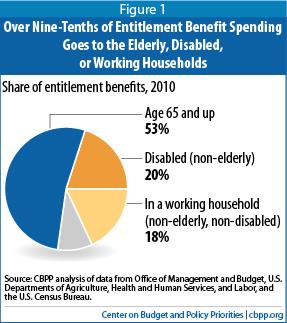
CBPP analysis of budget and Census data shows that more than 90
percent of the benefit dollars that entitlement and other
mandatory programs spend go to assist people who are elderly,
seriously disabled, or members of working households — not to
able-bodied, working-age Americans who choose not to work.
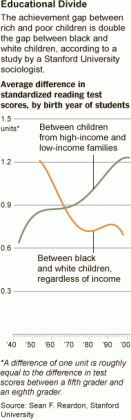
Education has historically been considered a great equalizer in
American society, capable of lifting less advantaged children and
improving their chances for success as adults. But this article
maintains that a body of recently published scholarship is
suggesting that the achievement gap between rich and poor
children is widening.