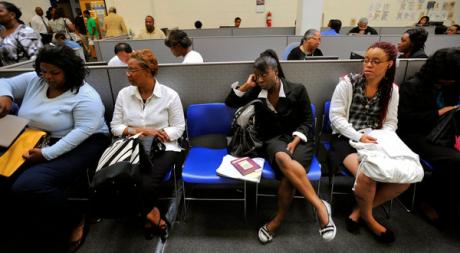
People in California who earn a career technical education (CTE)
degree or certificate from a community college earn more money —
an average increase in income of 33 percent or 13 to 22 percent
overall, respectively. Those are two findings from a research
project undertaken by the Center for Poverty Research at the
University of California, Davis.
Community college programs in career and technical education —
especially in health professions — lead to significant financial
returns, especially for women, according to a new policy brief by
the UC Davis Center for Poverty Research.
When Americans talk about the failings of the country’s economy,
the focus is usually on inequality—the uneven distribution of
prosperity among the population. Poverty, on its own terms,
receives less attention.
That’s not the case in a necessary new book by Kathryn J. Edin
and H. Luke Shaefer, $2.00 a Day: Living on Almost Nothing
in America. In it, they report on the roughly 1.5 million
households that are surviving on cash incomes of practically
nothing and not much in the way of government assistance.
In 2010, an estimated 2.7 million children and one in nine
African-American children had an incarcerated parent. Now,
consider new research from the UC Davis Poverty Center that finds
children whose parents are in prison have worse health, poorer
school performance and are at a greater risk for depression,
anxiety, asthma and HIV/AIDS. The UC Davis report finds that a
parent’s incarceration has long-lasting effects on his or her
children.
In his State of the City speech Thursday night, Sacramento Mayor
Kevin Johnson said he wanted to put together a task force to look
at raising the minimum wage in the capital city.
Currently, the city’s minimum wage is the same as California’s
state minimum wage — $9 per hour. In 2016, it will increase to
$10 per hour. But some cities across the nation, such as San
Francisco and Seattle, have sought higher minimum wages for their
workers.
President Obama’s proposal to make community colleges free is a
valiant effort to address the rising demand for skilled workers
throughout the nation and to improve college access for
low-income students. As states consider his proposal, they would
be wise to look to California. Our research in the state suggests
that low tuition can put higher education within reach for many
low-income students, but it is no panacea. Even with high
participation levels and nearly free community college, many
California students do not complete degrees.
A lack of access to clean drinking water in rural California farm
communities is leading residents to turn to sugary drinks and
soda, contributing to obesity and Type 2 diabetes, researchers
said in a new policy paper. The report, from the University
of California Davis Center for Poverty Research, finds that many
agricultural immigrant communities in California’s Central Valley
have difficulty obtaining clean, drinkable water.
Latino Americans suffer from disproportionately high rates of
obesity—especially children, who are 51 percent more likely to be
obese than their white counterparts. Unhealthy advertising from
food companies, a lack of access to safe and adequate
recreational areas, and poor snack and beverage options at
schools have all been cited as major contributors to this
early-life epidemic.
On the face of it, then, the War on Poverty seems to have
accomplished nothing. Critics of Johnson’s programs may also add
that the War on Poverty resulted in billions of dollars spent on
the poor. Why has there been no return on that investment?
The simple answer is that there have been improvements—but the
way we measure poverty hasn’t, until recently, accounted for
them.
The fundamental rights of millions of Texas women are at stake in
a case in which the 5th Circuit Court of Appeals heard oral
arguments on Wednesday. The case, Whole Woman’s Health v. Lakey,
will determine the constitutionality of a Texas law that imposes
ambulatory surgical center regulations on abortion providers. The
judges will essentially decide if women living outside the
state’s major metropolitan areas, and who therefore must travel
considerable distances to reach the few abortion providers able
to comply, are constitutionally relevant.
US President Barack Obama angered many – and pleased few – when
he announced plans last week to reform parts of the US
immigration system without Congressional approval.
But one potential impact of his plan – the boost it will provide
to the US economy – could help sway many Americans who are still
primarily concerned with the sluggish pace of the recovery.
While Solano County and the rest of the nation continues to show
signs of moving past the recession, poverty among women continues
to linger.
State and local representatives gathered Tuesday morning to hear
about the impacts poverty has on women and collaborate on the
needed steps to improve the situation.
Deported parents face no good solutions to the dilemma of forced
separation from their children: Either they remove their children
from their country of citizenship, or deportees return to rejoin
their children, facing harsh penalties if caught.
Many in Houston regularly face the terrible prospect.
peakers from Solano County Health and Social Services and UC
Davis Center for Poverty Research will discuss the structure of
poverty in the United States and Solano County and address ways
to approach local resources and services in the community, making
them available to women and children.
Ann Huff Stevens was named interim dean of the UC Davis Graduate
School of Management. She will begin Oct. 1.
Stevens is currently a professor and the chairwoman department of
economics. She is also director of the Center for Poverty
Research at University of California Davis.
DAVIS, Calif. — The UC Davis Center for Poverty Research has
launched a program to host undergraduates from Historically Black
Colleges and Universities (HBCUs) for summer experiences with
poverty research and mentorship toward academic careers.
Is a family with a car in the driveway, a flat-screen television
and a computer with an Internet connection poor?
Americans — even many of the poorest — enjoy a level of material
abundance unthinkable just a generation or two ago. That
indisputable economic fact has become a subject of bitter
political debate this year, half a century after President Lyndon
B. Johnson declared a war on poverty.
When people visit with friends and neighbors in southern West
Virginia, where paved roads give way to dirt before winding
steeply up wooded hollows, the talk is often of lives that never
got off the ground.
“How’s John boy?” Sabrina Shrader, 30, a former neighbor, asked
Marie Bolden one cold winter day at what Ms. Bolden calls her
“little shanty by the tracks.”
Ask Anne Valdez what poverty means for her, and her answer will
describe much more than a simple lack of money.
“It’s like being stuck in a black hole,” says Valdez, 47, who is
unemployed and trying to raise a teenage son in Coney Island, New
York City. “Poverty is like literally being held back from
enjoying life, almost to the point of not being able to breathe.”
For years, researchers have complained that the way the
government measures income and poverty is severely flawed, that
it provides an incomplete — and even distorted — view.
President Obama is hoping to fight poverty, in five so-called
“promise zones.” The government is targeting those areas for
economic revitalization. Host Michel Martin and U.S. Agriculture
Secretary Tom Vilsack take a look at the rural communities
involved, and the special challenges to fight poverty there.
Growing up poor has long been associated with reduced educational
attainment and lower lifetime earnings. Some evidence also
suggests a higher risk of depression, substance abuse and other
diseases in adulthood. Even for those who manage to overcome
humble beginnings, early-life poverty may leave a lasting mark,
accelerating aging and increasing the risk of degenerative
disease in adulthood.
Fifty years ago today, President Lyndon Johnson stood before
Congress and declared an “unconditional war on poverty in
America.” His arsenal included new programs: Medicaid, Medicare,
Head Start, food stamps, more spending on education, and tax cuts
to help create jobs.
WASHINGTON — To many Americans, the war on poverty declared 50
years ago by President Lyndon B. Johnson has largely failed. The
poverty rate has fallen only to 15 percent from 19 percent in two
generations, and 46 million Americans live in households where
the government considers their income scarcely adequate.
CHARLESTON, S.C. — For many, a $10 or $20 cut in the monthly food
budget would be absorbed with little notice.
But for millions of poor Americans who rely on food stamps,
reductions that began this month present awful choices. One
gallon of milk for the kids instead of two. No fresh broccoli for
dinner or snacks to take to school. Weeks of grits and margarine
for breakfast.
And for many, it will mean turning to a food pantry or a soup
kitchen by the middle of the month.
RICHMOND, Va. — Dressed on an unseasonably warm day, as ever, in
a tailored suit, tie and pocket square, Mayor Dwight C. Jones, a
fourth-generation pastor, arrived at a late-afternoon meeting
this month to talk about his ambitious — some say quixotic — plan
to subdue poverty in this city, once the capital of the
Confederacy and now one of the nation’s poorest urban areas.
Many Richmond residents live in public housing, but the mayor has
been promoting mixed-income communities.
Los Angeles has the highest poverty rate among California
counties, according to a new analysis announced Monday that
upends traditional views of rural and urban hardship by adding
factors such as the soaring price of city housing.
The measurement, developed by researchers with the Public Policy
Institute of California and the Stanford Center on Poverty and
Inequality, found that 2.6 million, or 27%, of Los Angeles County
residents lived in poverty in 2011. The official poverty rate for
the county, based on the U.S. Census’ 2011 American Community
Survey, is 18%.
The gap between America’s best-off and worst-off is widening—and
driving a wedge between young people with the resources to strike
out on their own and those for whom living with family or friends
has become, at least for now, an economic necessity.
The odds that a young adult in the U.S. will become the head of a
household, whether as an owner or renter, has fallen more between
1990 and 2010 than in previous decades, accelerating a trend that
began with the Baby Boomers, according to an analysis of Census
Bureau data by Emily Rosenbaum, a demographer at Fordham
University.
Facing the prospect of a prolonged federal government shutdown,
Gov. Jerry Brown will soon need to decide if the state will
shoulder the cost to keep running federal programs used by
millions of Californians.
State officials say there’s no guarantee that critical social
services in California — such as food stamps, subsidized school
meals and nutrition assistance for pregnant women and infants —
could run without interruption in November.
The Brown administration has not yet said if it plans to plug the
gaps for social programs at the end of the month.
The racial wage gap in the United States — the gap in salary
between whites and blacks with similar levels of education and
experience — is shaped by geography, according to new social
science research.
The larger the city, the larger the racial wage gap, according to
researchers Elizabeth Ananat, Shihe Fu and Stephen L. Ross, whose
findings were recently by the National Bureau of Economic
Research.
A growing number of American workers are confronting a
frustrating predicament on payday: to get their wages, they must
first pay a fee.
For these largely hourly workers, paper paychecks and even direct
deposit have been replaced by prepaid cards issued by their
employers. Employees can use these cards, which work like debit
cards, at an A.T.M. to withdraw their pay.
At least one part of the labor force has expanded significantly
since the recession hit: the low-wage part, made up of burger
flippers, home health aides and the like.
Put simply, the recession took middle-class jobs, and the
recovery has replaced them with low-income ones, a trend that has
exacerbated income inequality. According to Labor Department
data, about 1.7 million workers earned the minimum wage or less
in 2007. By 2012, the total had surged to 3.6 million, with
millions of others earning just a few cents or dollars more.
Forced federal spending cuts intended to be equal and
across-the-board have lately fallen harder on the nation’s poor,
sick and elderly.
At the other end, the top brass of federal employees are on track
to receive bonuses. And workers who impact the food and airline
businesses, like meat inspectors and air traffic controllers,
have managed to get a break from Congress.
Poverty is an exam room familiar. From Bellevue Hospital in New
York to the neighborhood health center in Boston where I used to
work, poverty has filtered through many of my interactions with
parents and their children.
WASHINGTON — Why are so many American families trapped in
poverty? Of all the explanations offered by Washington’s
politicians and economists, one seems particularly obvious in the
low-income neighborhoods near the Capitol: because there are so
many parents like Carl Harris and Charlene Hamilton.
For most of their daughters’ childhood, Mr. Harris didn’t come
close to making the minimum wage. His most lucrative job, as a
crack dealer, ended at the age of 24, when he left Washington to
serve two decades in prison, leaving his wife to raise their two
young girls while trying to hold their long-distance marriage
together.
CBO finds that during the past 40 years, federal spending for 10
of the major means-tested programs and tax credits for low-income
households more than tripled as a share of GDP. In 2012, such
spending totaled $588 billion, one-sixth of all federal outlays.
Over the next decade, spending on those programs will continue to
rise under current law, CBO projects, driven mainly by growth in
Medicaid and other means-tested health care programs.
The report was written by Will Carrington, Molly Dahl, and Justin
Falk, with assistance from other CBO staff.
SACRAMENTO — The state Legislature gaveled in a special session
on healthcare Monday, pushing forward with sweeping proposals to
help California implement President Obama’s healthcare overhaul.
The measures, including a major expansion of Medi-Cal, the
state’s public insurance program for the poor, would cement the
state’s status as the nation’s earliest and most aggressive
adopter of the federal Affordable Care Act. Beginning in January
2014, the law requires most Americans to buy health insurance or
pay a penalty.
Across the United States, the number of hungry and homeless
people is growing, and budget fights at the federal level are
threatening the aid many need to survive, the U.S. Conference of
Mayors said on Thursday.
Across the country, tens of thousands of underemployed and
jobless young people, many with college credits or work
histories, are struggling to house themselves in the wake of the
recession, which has left workers between the ages of 18 and 24
with the highest unemployment rate of all adults.
WASHINGTON (AP) — The ranks of America’s poor edged up last year
to a high of 49.7 million, based on a new census measure that
takes into account medical costs and work-related expenses.
The share of Americans in poverty in 2011 remained unchanged for
the first time in four years, the Census Bureau reported on
Wednesday, surprising economists who had expected the rate to
rise yet again. Still, the report showed a decline in the incomes
of middle-class Americans, offering a reminder that many American
families have yet to experience gains from the weak economic
recovery. Median household income, adjusted for inflation, was
$50,054 last year, officials said, a decrease of 1.5 percent from
2010. The level was about 8 percent lower than in 2007, the year
before the recession began. The measure peaked in 1999, when the
median income for American households reached $53,252.
With Google’s promise last year to wire homes, schools, libraries
and other public institutions in this city with the nation’s
fastest Internet connection, community leaders on the long
forlorn, predominantly black east side were excited, seeing a
potentially uplifting force. They anticipated new educational
opportunities for their children and an incentive for developers
to build in their communities. But in July, Google announced a
process in which only those areas where enough residents
preregistered and paid a $10 deposit would get the service,
Google Fiber. While nearly all of the affluent, mostly white
neighborhoods here quickly got enough registrants, a broad swath
of black communities lagged.
“This is just one more example of people that are lower income,
sometimes not higher educated people, being left behind,” said
Margaret May, the executive director of the neighborhood council
in Ivanhoe, where the poverty rate was more than 46 percent in
2009. “It makes me very sad.”
A record number of Americans—46.7 million, or nearly 1 in 7–now
uses the food stamp program, according to the Department of
Agriculture. The annual cost of SNAP (the Supplemental Nutrition
Assistance Program, as the food stamp program is officially
known) hit $72 billion last year, up from $30 billion four years
earlier. SNAP’s swelling size and cost have earned it fresh
scrutiny from critics, who say SNAP is making two different
constituencies fat—big corporations and the poor—the first,
figuratively; the second, literally. Many health advocates,
concerned by Americans’ increasing obesity, argue that food stamp
purchases should be disallowed for items high in salt or fat or
sugar—candy, say, or fatty meats, potato chips and soda.
Poverty takes many tolls, but in the United States, one of the
most tragic has been its tight link with a group of infections
known as the neglected tropical diseases, which we ordinarily
think of as confined to developing countries.
The neglected tropical diseases thrive in the poorer South’s warm
climate, especially in areas where people live in dilapidated
housing or can’t afford air-conditioning and sleep with the
windows open to disease-transmitting insects. They thrive
wherever there is poor street drainage, plumbing, sanitation and
garbage collection, and in areas with neglected swimming pools.
They can even increase the levels of poverty in these areas by
slowing the growth and intellectual development of children and
impeding productivity in the work force. They are the forgotten
diseases of forgotten people, and Texas is emerging as an
epicenter.
Hardship has built a stronghold in the American suburbs. Whatever
image they had as places of affluence and stability was badly
shaken last year, when reports analyzing the 2010 census made it
clear that the suburbs were getting poorer. While the overall
suburban population grew slightly during the previous decade, the
number of people living below the poverty line in the suburbs
grew by 66 percent, compared with 47 percent in cities. The trend
quickened when the Great Recession hit, as home foreclosures and
unemployment surged. In 2010, 18.9 million suburban Americans
were living below the poverty line, up from 11.3 million in 2000.
Three years ago, Gina Ray, who is now 31 and unemployed, was
fined $179 for speeding. She failed to show up at court (she says
the ticket bore the wrong date), so her license was revoked.
When she was next pulled over, she was, of course, driving
without a license. By then her fees added up to more than $1,500.
Unable to pay, she was handed over to a private probation company
and jailed — charged an additional fee for each day behind bars.
It took 14 years of patience, determination and self-confidence —
along with a key measure of local support — for a former foster
child from the streets of Oakland to graduate from UC
Davis. Joe Jackson, 34, earned his bachelor’s degree last
week in women and gender studies, completing a college odyssey
that began nearly a decade and a half earlier at Laney Community
College in Oakland.
Some may say it’s a miracle that Jackson even got into college to
begin with. Few former foster kids make the same journey. A study
by Annie E. Casey Foundation found that only 15 percent of youths
in foster care were enrolled in college preparatory classes,
versus 32 percent of students not in foster care. Fewer than 15
percent of foster children begin college while fewer than 2
percent go on to get a four-year degree.
Most of those who do graduate from college do so with the help of
some type of assistance. In Jackson’s case, that was the Guardian
Scholar program at UCD, which helped him with tuition, housing
and counseling.
These are anxious days for American workers. Many, like Ms.
Woods, are underemployed. Others find pay that is simply not
keeping up with their expenses: adjusted for inflation, the
median hourly wage was lower in 2011 than it was a decade
earlier, according to data from a forthcoming book by the
Economic Policy Institute, “The State of Working America, 12th
Edition.”
Household wealth is dropping. The Federal Reserve reported last
week that the economic crisis left the median American family in
2010 with no more wealth than in the early 1990s, wiping away two
decades of gains.
Poor, urban, and minority residents are most at risk for health
problems linked to climate change, according to a California
Department of Public Health analysis of Los Angeles and Fresno
counties. The department examined social and environmental
factors ranging from the rising sea level to public
transportation access and found that African Americans and
Latinos living in these counties are more likely to be exposed to
health and safety risks related to poor air quality, heat waves,
flooding, and wildfires stemming from climate change.
The study also found that there was a notable economic disparity
between families living in the areas most vulnerable to climate
change and those who didn’t — the more at-risk families earned
between 40 and 55 percent less each year than the least
vulnerable families. Residents living downtown or in urban areas
were also more vulnerable, the study said. A western portion of
Fresno County near Mendota also was found to be especially
susceptible to climate change-related safety and health problems.