

Impacts of Eviction on College Students Greatest Among Black Female Parents
By Nick Graetz, University of Minnesota, and Adam Chapnik, Yale University

Eviction rates in the U.S. are twice as high for renters with children. This includes college students, one in five of whom are parents. In a recent study, we examined eviction rates among college students, including those with children.
We found that students threatened with eviction earned less post-enrollment, were less likely to complete their degree, and were less likely to be married post-enrollment. Their rates of post-enrollment mortality were higher, too. We also found that the majority of parenting students threatened with eviction were female and Black. Parenting students threatened with eviction were less than half as likely to complete their degree than those who were not.
These findings highlight the long-term economic and health impacts of housing insecurity during college, especially for parenting students. Policymakers should note that ensuring stable housing for parenting students may have substantial multigenerational benefits for economic mobility and population health.
Key Facts
- The majority of parenting students threatened with eviction are female and Black.
- Students threatened with eviction earn less post-enrollment, are less likely to complete their degree, and are less likely to be married post-enrollment.
- Ensuring stable housing for parenting students may have substantial multigenerational benefits for economic mobility and population health, especially among Black women and their children.
Background
Each year, roughly 2.7 million renter households in the U.S. are threatened with eviction (that is, have an eviction filed against them).[1] Though they are often overlooked in this context, many college students are exposed to such housing insecurity. This is especially true of parenting students, who—due to increasingly high childcare and rental housing costs—may be at increased risk of eviction.[2,3,4] Beyond the typical consequences of this kind of housing insecurity, eviction among student parents may have intergenerational consequences by reducing the likelihood of the parent completing college.
Investigating rates and consequences of eviction among college students
In our study[5], we investigated the consequences of eviction among college students, parenting and non-parenting. To do so, we linked 11.9 million student records to eviction filings from housing courts, demographic characteristics reported in decennial census and survey data, incomes reported on tax returns by students and their parents, and dates of birth and death from the Social Security Administration. We drew in part on Post-Secondary Employment Outcomes (PSEO) data from 2021-22.[6] Though PSEO does not cover all U.S. states, it represents one of the most comprehensive data efforts to date in linking students records to other census and administrative data sources. We established parenting status by combining PSEO data with Census Household Composition Key (CHCK) records created by the Census Bureau.[7] To track evictions among college students in our sample, we drew on court records compiled by the Eviction Lab at Princeton University. To estimate the impacts of eviction on non-parenting and parenting students—including degree completion, household income, marital status, and mortality—we linked individuals across data sources using Protected Identification Keys (PIKs).
Young Black female parenting students suffer greatest exposure to eviction and its negative impacts
We found that students threatened with eviction were more likely to be female and Black compared to their non-threatened peers (see Figure 1). This was especially true for parenting students (81 percent vs. 63 percent female, 57 percent vs. 20 percent Black), but also for non-parenting students. Threatened parenting students also tended to be younger, with 44 percent aged between 18 and 24. In terms of outcomes, we found that being threatened with an eviction was significantly associated with lower likelihood of degree completion, lower post-grad income, lower likelihood of being married post-grad, and higher post-grad mortality. With the exception of post-grad mortality, we also found that these associations were significantly larger for parenting students.
Among non-parenting students, 53 percent of non-threatened students completed a bachelor’s degree, compared to just 30 percent of threatened students. Among parenting students, 38 percent of non-threatened students completed a bachelor’s degree, compared to just 15 percent of threatened students.
At $59,000, joint income five years post-grad was substantially lower for threatened parenting students than for their non-threatened peers ($126,000). Among parenting students, 66 percent of non-threatened students were married five years post-grad, compared to 26 percent of threatened students. The mortality rate 10-years post-grad was 290 per 100,000 for threatened parenting students, compared to 140 for non-threatened parenting students. In other words, an eviction filing was associated with a 107-percent increase in risk of death over the next ten years.
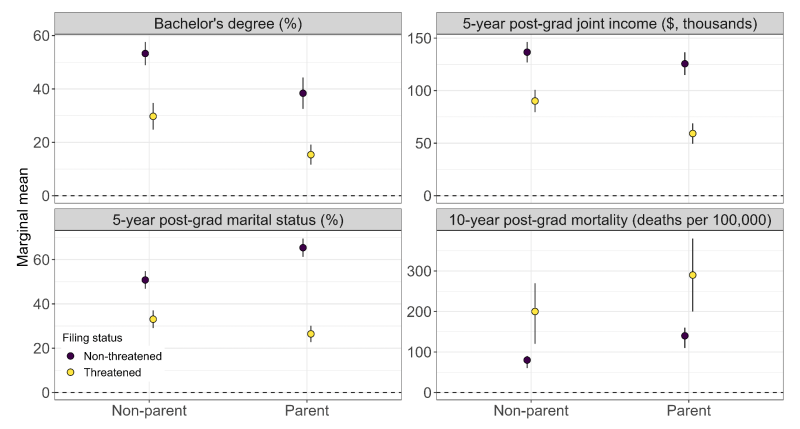
Figure 1. Average marginal predictions for all outcomes based on parenting status and filing while enrolled.
Support parenting students to reduce evictions and improve long-term prospects
Our study highlights the disproportionate threat of eviction faced by Black women parenting students. Among those linked to eviction filings, 81 percent were women despite making up only 63 percent of parenting students, while 57 percent were Black students despite representing just 20 percent of that group. These disparities mirror broader national patterns, indicating that higher education institutions currently do not do enough to shield vulnerable populations from the racialized nature of housing insecurity.
Facing eviction while enrolled in college significantly reduces the likelihood of completing a degree, lowers post-graduation income, and increases the risk of death within ten years of graduation. While parenting students generally marry at higher rates than their non-parenting peers (65 percent vs. 51 percent), this trend reverses among those threatened with eviction: only 26 percent of parenting students under threat of eviction are married, compared to 33 precent of their non-parenting counterparts. This suggests that eviction disproportionately affects single parenting students, potentially contributing to relationship instability or reflecting their existing vulnerability.
Our findings suggest that housing security plays a crucial role in educational and long-term success, particularly for parenting students—a group that constitutes one in five undergraduates in the U.S. Policymakers and college administrators should reevaluate how housing costs are considered in student financial planning and consider institutional investment in housing support. Such measures could not only improve retention and graduation rates but also lead to meaningful economic benefits for single parenting students in the long term.
Nick Graetz is an assistant professor in the Department of Sociology at the University of Minnesota.
Adam Chapnik is a PhD student at Yale University.
References
1. Gromis, Ashley, Ian Fellows, James R. Hendrickson, Lavar Edmonds, Lillian Leung, Adam Porton, and Matthew Desmond. 2022. “Estimating Eviction Prevalence across the United States.” Proc Natl Acad Sci USA 119(21). doi:10.1073/pnas.2116169119.
2. Cameron, Margaux, Ruby Johnson, T. Austin Lacy, Joanna Wu, Peter Siegel, Jordan Holley, and Jennifer Wine. 2023. 2019–20 National Postsecondary Student Aid Study (NPSAS:20) First Look at Student Financial Aid Estimates for 2019–20. National Center for Education Statistics.
3. Airgood-Obrycki, Whitney, Alexander Hermann, and Sophia Wedeen. 2021. “The Rent Eats First: Rental Housing Unaffordability in the US.” Joint Center for Housing Studies Harvard University.
4. Joint Center for Housing Studies. 2024. The State of the Nation’s Housing 2024.
5. Graetz, Nick, Adam Chapnik, Danielle H. Sandler, And Sonya R. Porter (2025). Consequences of Eviction for Parenting and Non-parenting College Students (CES Working Paper No. 25-35). U.S. Census Bureau. https://www.census.gov/library/working-papers/2025/adrm/CES-WP-25-35.html
6. U.S. Census Bureau. 2025. “Post-Secondary Employment Outcomes Data (Experimental) (2001-2021).”
7. Genadek, Katie, Joshua Sanders, and Amanda Stevenson. 2022. “Measuring US Fertility Using Administrative Data from the Census Bureau.” Demographic Research 47:37–58. doi:10.4054/DemRes.2022.47.2.