

Discrimination and Economic Hardship in Adolescence Linked to Depression and Biological Stress Among Latino Young Adults
By Madeleine R. Frazier, Amanda E. Guyer, Paul D. Hastings, Richard W. Robins, and Johnna R. Swartz, UC Davis

Children and adolescents who experience adversity are at greater risk for depression and stress-induced physical wear and tear, known as higher allostatic load (AL). Individuals of Mexican origin may face multiple forms of adversity related to their ethnicity and class, including ethnic discrimination and economic hardship, the experience of which may further depend on sex.
In a recent study of 208 Mexican-origin participants, we assessed associations between these two types of adolescent adversity and outcomes of both young-adult depression and AL.
We found that adolescents who reported greater ethnic discrimination experienced higher levels of depression at age 26. In addition, depression levels at age 26 influenced the relationship between economic hardship during adolescence and allostatic load at age 26.
Participants who had low depression symptoms in young adulthood despite experiencing higher levels of economic hardship in adolescence had higher levels of AL in young adulthood. This finding is consistent with theoretical frameworks that suggest that psychologically coping with longer-term adverse experiences may come at a cost to physical health.
Our findings suggest that interventions intended to benefit Latino adolescents and promote sustainable, holistic resilience may help to mitigate the detrimental impacts of ethnic discrimination and economic hardship on their development.
Key Facts
- Latino adolescents who reported greater ethnic discrimination experienced higher levels of depression at age 26.
- Latino adolescents who were psychologically resilient to greater economic hardship still experienced higher levels of stress-induced physical wear and tear, known as allostatic load, at age 26.
- Interventions to promote resilience among Latino adolescents may help to mitigate the detrimental impacts of ethnic discrimination and economic hardship on their development.
Background
Adolescence is a key developmental period in which stress can shape long-term mental and physical health because of rapid neurobiological changes.[1] Racially and ethnically minoritized youth are more likely to experience chronic stressors, including discrimination and economic hardship, which may increase risk for stress-related disorders such as Major Depressive Disorder (MDD) and poor physical health in adulthood.[2] Chronic stress can lead to high allostatic load (AL), dysregulating biological systems involved in stress responses such as the hypothalamic-pituitary-adrenal (HPA) axis, immune, cardiovascular, and metabolic systems.[3] Higher AL has also been associated with MDD.[4]
Multiple forms of social inequality may jointly influence health outcomes, particularly among Latino youth.[5] Perceived discrimination has been linked to depression, psychological distress, altered cortisol rhythms, and higher AL.[6,7] Similarly, childhood poverty and low socioeconomic status are associated with increased risk for adult depression and higher AL.[8,9]
Some studies have suggested a “skin-deep resilience” pattern, in which individuals outwardly show positive psychological adjustment despite adversity, but then experience greater physiological strain over time.[10] In our study, we examined whether adolescent discrimination and economic hardship predicted depression and AL at age 26 among Mexican-origin individuals, and whether these associations differed by sex.[11]
Exploring the impact of discrimination and economic hardship
We used longitudinal data from the California Families Project (CFP), a study of 674 Mexican-origin families in Northern California. The study began when children (50 percent female) were approximately 10 years old in 2006 and has followed them over time into young adulthood. Child participants reported annually on perceptions of discrimination, and their mothers reported on household income and household size every year as well as economic security every other year. At approximately age 26, participants were assessed on a range of markers indicative of AL and symptoms of depression.
For our study, we drew on a range of measures covered by the CFP. These included economic hardship, perceived discrimination, depression, and markers of AL, including blood pressure, waist-to-hip ratio, body mass index (BMI), and blood biomarkers such as cholesterol and triglycerides. We then conducted various analyses using statistical modelling.
Individuals may appear emotionally resilient while showing signs of increased biological stress
We found that higher levels of perceived ethnic discrimination during adolescence predicted slightly higher depression symptoms at age 26. However, this association became non-significant after accounting for earlier depression symptoms and applying stricter statistical corrections. Adolescent discrimination was not significantly associated with AL at age 26.
Economic hardship during adolescence was not significantly associated with either depression or AL at age 26 when these measures were examined independently. Overall, we did not find strong evidence that adolescent economic hardship independently predicted poorer mental or physical health in young adulthood. Depression symptoms and allostatic load at age 26 were not significantly associated overall.
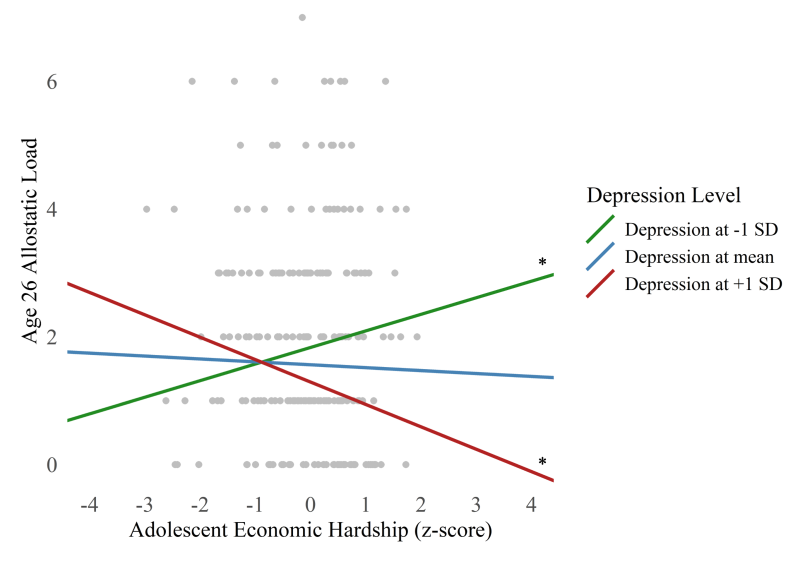
Figure 1. Interaction between adolescent economic hardship and age 26 depression in predicting AL. (*Denotes p value <.05)
Although, for adolescent economic hardship, our findings did suggest a possible “skin-deep resilience” pattern. Among participants who experienced higher economic hardship in adolescence, those reporting lower depression symptoms exhibited higher allostatic load at age 26, compared to those reporting higher depression symptoms. These results suggest some individuals may appear outwardly emotionally resilient while still showing signs of increased biological stress. However, these effects were modest and would not hold after applying stricter statistical corrections. Lastly, we found no significant differences between men and women.
Promoting resilience may mitigate health impacts of discrimination and hardship
Our goal was to test two models of the association between discrimination and economic hardship in adolescence and depression symptoms and AL in young adulthood in a sample of Mexican-origin women and men. We found partial support for the ‘resilience is skin deep’ hypothesis, suggesting that psychological resilience to chronic poverty across the teenage years may come at the cost of additional physical strain resulting from high-effort adaptation to cumulative stress.
These results suggest that the strain associated with coping with chronic adversity such as economic hardship may come at a cost to physical health in Mexican-origin emerging adults. Policymakers should consider intervention work that benefits Latino adolescents and promotes sustainable, holistic resilience, which may help mitigate the detrimental impacts of ethnic discrimination and economic hardship on their adult development.
Madeleine R. Frazier is a PhD candidate in human development at UC Davis.
Amanda E. Guyer is a professor of human development and family studies at UC Davis.
Paul D. Hastings is a professor of psychology at UC Davis.
Richard W. Robins is a professor of psychology at UC Davis.
Johnna R. Swartz is an associate professor of human development and family studies at UC Davis.
References
1. Mancini, G.F., Meijer, O.C., Campolongo, P., 2023. Stress in adolescence as a first hit in stress-related disease development: Timing and context are crucial. Front. Neuroendocrinol. 69, 101065. https://doi.org/10.1016/j.yfrne.2023.101065.
2. Hastings, P.D., Guyer, A.E., Parra, L.A., 2022. Conceptualizing the Influence of Social and Structural Determinants of Neurobiology and Mental Health: Why and How Biological Psychiatry Can Do Better at Addressing the Consequences of Inequity. Biol. Psychiatry Cogn. Neurosci. Neuroimaging 7, 1215–1224. https://doi.org/10.1016/j.bpsc.2022.06.004.
3. Seeman, T.E., McEwen, B.S., Rowe, J.W., Singer, B.H.., 2001. Allostatic load as a marker of cumulative biological risk: MacArthur studies of successful aging. Proc. Natl. Acad. Sci. 98, 4770–4775. https://doi.org/10.1073/pnas.081072698.
4. Honkalampi, K., Virtanen, M., Hintsa, T., Ruusunen, A., Mäntyselkä, P., Ali-Sisto, T., Kärkkäinen, O., Koivumaa-Honkanen, H., Valkonen-Korhonen, M., Panayiotou, G., Lehto, S.M. 2021. Comparison of the level of allostatic load between patients with major depression and the general population. Journal of Psychosomatic Research, 143, 110389. https://doi.org/10.1016/j.jpsychores.2021.110389.
5. Hankivsky, O., Doyal, L., Einstein, G., Kelly, U., Shim, J., Weber, L., Repta, R., 2017. The odd couple: using biomedical and intersectional approaches to address health inequities. Glob. Health Action 10, 1326686. https://doi.org/10.1080/ 16549716.2017.1326686.
6. Araújo, B.Y., Borrell, L.N., 2006. Understanding the link between discrimination, mental health outcomes, and life chances among Latinos. Hisp. J. Behav. Sci. 28, 245–266. https://doi.org/10.1177/0739986305285825.
7. Cuevas, A.G., Wang, K., Williams, D.R., Mattei, J., Tucker, K.L., Falcon, L.M., 2019. The Association Between Perceived Discrimination and Allostatic Load in the Boston Puerto Rican Health Study. Psychosom. Med. 81, 659. https://doi.org/10.1097/ PSY.0000000000000715.
8. Yali, Z., Jiangen, Z., Hongxia, L.I., Yongzhi, J., 2022. The relationship between socioeconomic status and depression: A systematic review and meta-analysis. Adv. Psychol. Sci. 30, 2650. https://doi.org/10.3724/SP.J.1042.2022.02650.
9. Evans, G.W., Kim, P., 2012. Childhood Poverty and Young Adults’ Allostatic Load: The Mediating Role of Childhood Cumulative Risk Exposure. Psychol. Sci. 23, 979–983. https://doi.org/10.1177/0956797612441218.
10. Brody, G.H., Yu, T., Chen, E., Miller, G.E., Kogan, S.M., Beach, S.R.H., 2013. Is resilience only skin deep?: Rural African Americans’ socioeconomic status–related risk and competence in preadolescence and psychological adjustment and allostatic load at age 19. Psychol. Sci. 24, 1285–1293. https://doi.org/10.1177/0956797612471954.
11. Frazier M.R., Guyer A.E., Hastings P.D., Robins R.W., Swartz J.R. 2026. Associations between adolescent adversity and young adult depression symptoms and allostatic load in Mexican-origin individuals. Psychoneuroendocrinology. 2026 Jun;188:107832. https://doi.org/10.1016/j.psyneuen.2026.107832