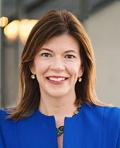
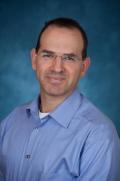
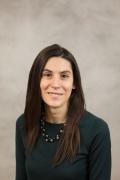
Dani Sandler will discuss Census Bureau data resources that can
be used for poverty and inequality research, including both
public use datasets and the process to request access to
confidential microdata through the Federal Statistical Research
Data Centers. The presentation will provide an overview of
available data products and walk through the steps for submitting
an FSRDC research proposal.
Sarah Brayne is an Associate Professor in the Department of
Sociology. In her research, she uses quantitative and qualitative
methods to understand whether and how data-intensive surveillance
shapes individual trajectories and population-level disparities.
Join this presentation by NIH officials to learn about the latest
developments in funding, reviews of applications, and how and
where funding opportunities will be posted. The presentation will
include a specific discussion of funding opportunities for
trainees and early-career investigators.
Join us for Well-Being Among Recent Migrants: A Showcase of
Research by Emerging Scholars, a mini-conference hosted by the
Center for Poverty & Inequality Research and the Global Migration
Center. Three Institute for Research on Poverty Visiting Scholars
will share their current research and engage in discussions with
experts in the field.
The project examines employers’ strategies for hiring people
disadvantaged in the labor market, with a particular focus on
individuals living in generational poverty and members of
marginalized Roma communities (MRC), to narrow the mismatch
between labor supply and demand.
Dr. Sophie McGuinness is an assistant professor of education
leadership and policy studies at Florida State University. Her
research uses tools in applied microeconomics to study education
policy with a focus on career and technical education, community
colleges, and workforce development. Her work has appeared in top
journals including Education Finance and
Policy, Journal of Research on Educational Effectiveness,
and Research in Higher Education. Her work has been
supported by the ECMC Foundation and Bonsal Family Foundation.
Join Dr. Lois Miller for a discussion on the effects of College
Transfers. Dr. Miller is an applied microeconomist with interests
in labor economics, public economics, and the economics of
education. She focuses her research on topics in higher
education, with a focus on how access and internal resources in
postsecondary education can affect inequality and social
mobility. Dr. Miller received her PhD in Economics from the
University of Wisconsin-Madison and her BA in Mathematics
from DePauw University.
Dr. Ito’s research addresses social psychological issues using a
multi-level approach that integrates social psychological and
neuroscience perspectives to better understand stereotyping,
prejudice, face perception, disparities in STEM education, and
adolescent substance use.
Amanda Agan’s research lies at the intersections of economics,
law, and public policy with a focus on the economics of crime and
labor market discrimination. Her work tries studies the
consequences and determinants of criminal legal involvement and
how various policies can change the incentives of defendants,
criminal justice actors, and people with records with a
particular emphasis on how criminal involvement impacts labor
market opportunities (and vice versa).
Dr. Ekjyot Saini earned her Ph.D. in Human Development and Family
Science from Auburn University, as well as a Masters in Social
Work from the University of Michigan. Her program of research
utilizes an interdisciplinary approach, including family systems
perspectives and biopsychosocial models, to understand how family
and sociocultural contexts contribute to the well-being of
children and families across developmental periods.
In the first two decades of the 21st century, more than two
million Mexican migrants returned to Mexico from the United
States. Between 2010 and 2020, the number of people who returned
to Mexico was so large that, for the first time in at least fifty
years, more people entered Mexico from the United States than
entered the United States from Mexico. Many of these migrants
were destined for urban areas, and we know little about how they
fare after they return to cities. In The Returned,
sociologists Claudia Masferrer, Erin R.
Abstract: In the US, work opportunities for
those with lower levels of formal education have moved in recent
years toward service employment, and this concentration is
especially strong among households with children. Even compared
to other jobs for those without college degrees, service work is
characterized by shorter tenure and less access to full-time
hours, patterns that are visible in national data and are more
pronounced for those with children.
Dr. Arline T. Geronimus is a renowned public health researcher,
professor, and author of Weathering: The Extraordinary
Stress of Ordinary Life in an Unjust Society, called a
“monumental” book by Ibram X. Kendi, author of How to be an
Antiracist.
Facilitated by Courtney Lyles and Marianne Page, this event
features short presentations by guest speakers followed by an
interactive Q+A. All UC Davis faculty, students and staff are
encouraged to register for the symposium. Light refreshments will
be provided for those who attend in-person.
Abstract: Children growing up in a low-income
context often demonstrate social, emotional, behavioral and
academic problems that are rooted in early childhood experiences
of adversity. In this presentation, I will share our recent
findings of the impact of income-related adversity on infants’
biological systems of self-regulation through its effects on
parental mental health and parenting.
The opioid crisis in the United States and Canada has reached
unprecedented levels. One understudied dimension is its impact on
the next generation. We use linked administrative data from the
Canadian province of British Columbia (where opioid death rates
exceed the US national average) that links birth records since
2000 to health, education, well-being and mortality for both the
mother and the child. We have three main findings.
Dr. Jake Rosenfeld is a Professor and Chair of Sociology and
Resident Fellow of the Weidenbaum Center on the Economy,
Government, and Public Policy at Washington University-St.
Louis.
Dr. Rosenfeld’s research and teaching focus on the political and
economic determinants of inequality in the United States and
other advanced democracies. He is primarily interested in the
determinants of wages and salaries, and how these vary across
time and place. He received his Ph.D. from Princeton
University.
Erin Hamilton studies when, why, and how people migrate, and with
what consequences for migrants, their families, and the
communities they leave and enter. She is currently working on
research projects on legal status, deportation, family and child
migration, and migrant health. She was a Fulbright-Garcia Robles
Scholar at El Colegio de Mexico in Mexico City in spring 2019.
Erin is the co-author, with Robert Hummer, of Population
Health in America.
In this talk, I will present a new conceptual model for examining
social class discrimination among adolescents. This form of
discrimination is defined as the bias that individuals experience
because they are disadvantaged in social class. For adolescents,
social class refers to their family’s income, education,
occupation, and position in society. Increases in economic
inequality worldwide are drawing attention to the powerful
associations between social class and adolescent development.
Rene Crespin is a Postdoctoral Fellow in the Department of
Economics at Michigan State University. His research focuses on
examining levers that lessen or exacerbate inequality,
specifically in terms of schools, housing, and neighborhoods.
Among his ongoing projects, he studies the economic and social
impacts of education and immigration policies.
Dr. Crespin will be joining us for a week through the Institute
for Research on Poverty Visiting Scholar Program.
How does unconditional income for families in poverty affect
parental investments for their young children? Mothers in four
U.S. metropolitan areas were randomized to receive a monthly
unconditional cash transfer of either $333/month (high) or
$20/month (low) for the first several years after child birth.
During the first three years, high-cash gift households spent
more money on child-specific goods and more time on
child-specific early learning activities than the low-cash gift
group.
Community-engaged research is a powerful strategy for gaining a
deeper understanding of lived experiences of poverty and economic
hardship, assessing services and programs, and informing systemic
change (Bertram & Bullock, 2023). Focusing on the Center for
Economic Justice and Action’s (CEJA) research collaborations with
nonprofit organizations, this presentation illuminates the
transformative potential of community-engaged research to advance
anti-poverty initiatives.
Abstract: Though Social Security is typically considered a
program to support retirees, nearly one in ten children live in a
home with Social Security income. Children are substantially more
likely to live with an older adult than they were two decades
ago, and are twice as likely to report Social Security income in
their household than traditional cash welfare. We use the sharp
increase in eligibility for Social Security benefits at age 62 to
investigate the role played by the Social Security program in
childhood economic outcomes among children who live with older
adults.
Jackelyn Hwang is an Assistant Professor in the Department of
Sociology and a faculty affiliate at the Center for Comparative
Studies in Race and Ethnicity and the Urban Studies
Program. Jackelyn’s main research interests are in the
fields of urban sociology, race and ethnicity, immigration, and
inequality. In particular, her research examines the relationship
between how neighborhoods change and the persistence of
neighborhood inequality by race and class in US cities.
Some eleven million undocumented immigrants reside in the United
States, carving out lives amid a growing web of surveillance that
threatens their and their families’ societal
presence. Engage and Evade examines how undocumented
immigrants navigate complex dynamics of surveillance and
punishment, providing an extraordinary portrait of fear and hope
on the margins.
Jacob William Faber is an Associate Professor at New
York University’s Robert F. Wagner School of Public
Service and holds a joint appointment in NYU’s
Sociology Department. His research and teaching focuses on
spatial inequality. He leverages observational and experimental
methods to study the mechanisms responsible for sorting
individuals across space and how the distribution of people by
race and class interacts with political, social, and ecological
systems to create and sustain economic disparities.
This paper examines whether a generous cash intervention early in
life can “undo” some of the long-term disadvantage associated
with poor health at birth. We use new linkages between several
large-scale administrative datasets to examine the short-,
medium-, and long-term effects of providing low-income families
with low birthweight infants support through the Supplemental
Security Income (SSI) program. This program uses a birthweight
cutoff at 1200 grams to determine eligibility.
Childhood poverty in the United States remains a persistent and
pervasive concern. Considerable research evidence links
childhood experiences of poverty to harmful effects on
developmental outcomes. Yet, less is known about how those
experiencing poverty perceive, interpret, and understand their
economic circumstances. To address this gap, this
qualitative study sought to understand family members’
perspectives of their economic circumstances.
UCI’s Center for Population, Inequality and Policy will invite
submissions to present at the inaugural All-UC Demography
Conference. This meeting will highlight current
demographic research happening within the UC system and provide a
venue for making connections across UC campuses, with a
keynote talk by Ron Lee, Distinguished Professor and
founding director of UC Berkeley Center for the Economics and
Demography of Aging.
Dr.
Weitzman is an assistant professor in the Department of
Sociology and a research affiliate of the Population Research
Center and the Long Institute for Latin American Studies at the
University of Texas. She received her PhD in Sociology from New
York University in 2015, before completing a 2-year postdoctoral
felllowship at the University of Michigan. Prior to completing
her PhD she served as a Peace Corps volunteer in Peru and Belize
and worked as an intern at the United Nations Development Fund
for Women.
Social determinants of health (SDOH) interventions within
clinical and community settings have been proposed as one
promising strategy to address socioeconomic hardships faced by
families in poverty, including Latina/os. Dr Martinez-Cardoso
will share the result of a mixed-methods study that was used to
examine the effects of Developmental Understanding and Legal
Collaboration for Everyone (DULCE), a pediatric SDOH
intervention, on outcomes among US-born and immigrant Latina/o
families.
Florencia Torche is Dunlevie Family Professor in the School
of Humanities and Sciences at Stanford University. Her research
and writing focus on social inequality and social mobility,
educational disparities, and marriage and family dynamics. Her
recent scholarship has extensively studied the influence of
early-life exposures and circumstances –starting before birth– on
individual health, development, and wellbeing using natural
experiments and causal inference approaches.
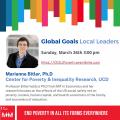
Event hosted by the United Nations Association, Sacramento
Chapter. CPIR Executive Committee Member Marianne Bitler is
participating.
The United Nations Association, Sacramento Chapter, is proud to
present the first of our “Global Goals Local Leaders” forums.
Each event will be dedicated to celebrating the Sustainable
Development Goals — and exploring how local leaders are making
these goals a reality in our own community.
This month, the inaugural forum will focus on Sustainable
Development Goal #1: No Poverty.
Do you want to know the oldest wine still in production
today?
Do you want to know what wines were in King Tut’s tomb?
Would you like to know if you pair wine with the meat or the
sauce?
Tune in for the Wine Master Class with Napa Valley winemaker Kira
Ballotta and learn about her newest wine project, Cantadora.
Laura Tach’s research and teaching interests focus on poverty and
social policy. In her research she uses quantitative and
qualitative methods to study how social policies can alleviate
poverty among disadvantaged families and communities.
Professor Hammond will present his paper entitled, On
Fires, Floods, and Federalism: Adapting Welfare Programs for the
Climate Crisis. Professor Hammond’s research contextualizes
the climate crisis in our scholarly understanding of the American
welfare state. Professor Hammond will explain how, amid the
recent spate of fires and floods, federal law has fared. His work
attends to the role of Congress, weakened as it is by increased
polarization and diminished capacity, and how the resulting
delays and distortions in emergency relief have hampered the
government response.
A religious leader, author and social activist, Campbell devoted
her career to using tax law to benefit the underserved. “It’s
about caring for those who are most often left out,” she said.
“From a young age, I just had this idea that you had to act. You
had to step in and fix things.”
Shortly after graduating from the School of Law, she founded the
Oakland Community Law Center, which provided legal services on a
sliding-fee scale.
IPR Director Diane Whitmore Schanzenbach is an economist who
studies policies aimed at improving the lives of children in
poverty, including education, health, and income support
policies. Her work traces the impact of major public policies
such as the Food Stamp Program, school finance reform, and early
childhood education on children’s long-term outcomes.
In this session, Dr. Taura Taylor shares the observation that
studies on social inequality, poverty, and marginalization, often
deemphasize agency. Centering self-sufficiency or highlighting
community initiatives to resolve discrimination and inequality
has the potential to minimize structural barriers and systemic
oppression. In addition, distinguished individual and community
practices may not implement broadly across intersecting statuses.
Attendees will receive an overview of the NIH application and
funding process, advice on interacting with program officials,
and information on behavioral and social science research funding
opportunities.
Abstract: This paper estimates the effect of community-level
homicides on language development in early childhood. It also
explores whether maternal efficacy and satisfaction moderate this
relationship. It uses data from the Early Childhood Longitudinal
Survey of Chilean children and their mothers matched to municipal
level homicides. The empirical strategy exploits variation in the
timing of survey data collection and municipal-level
homicides in models with municipality fixed effects.
Since 2010, student loan debt has become the second-highest debt
category for U.S. households. We examine how education
payment-to-income ratios (PIR) impact wealth accumulation across
the wealth distribution using a thresholding approach in quantile
regression. We use data from the last 3 survey rounds of the
Survey of Consumer Finances.